The composer
Mention teammates, point the agent at files, Sessions and skills, attach screenshots and logs, quote the transcript, dictate, and pick the model for your next message.
The composer at the bottom of every Session carries more than text. Point the agent at the exact file or Session you mean, bring in a teammate, hand it a skill, attach a screenshot or a log, quote a line from the transcript, or talk instead of typing. Use it to give the agent what it needs in one message instead of describing where to look. For sending, steering and queueing, see Talk to the agent.
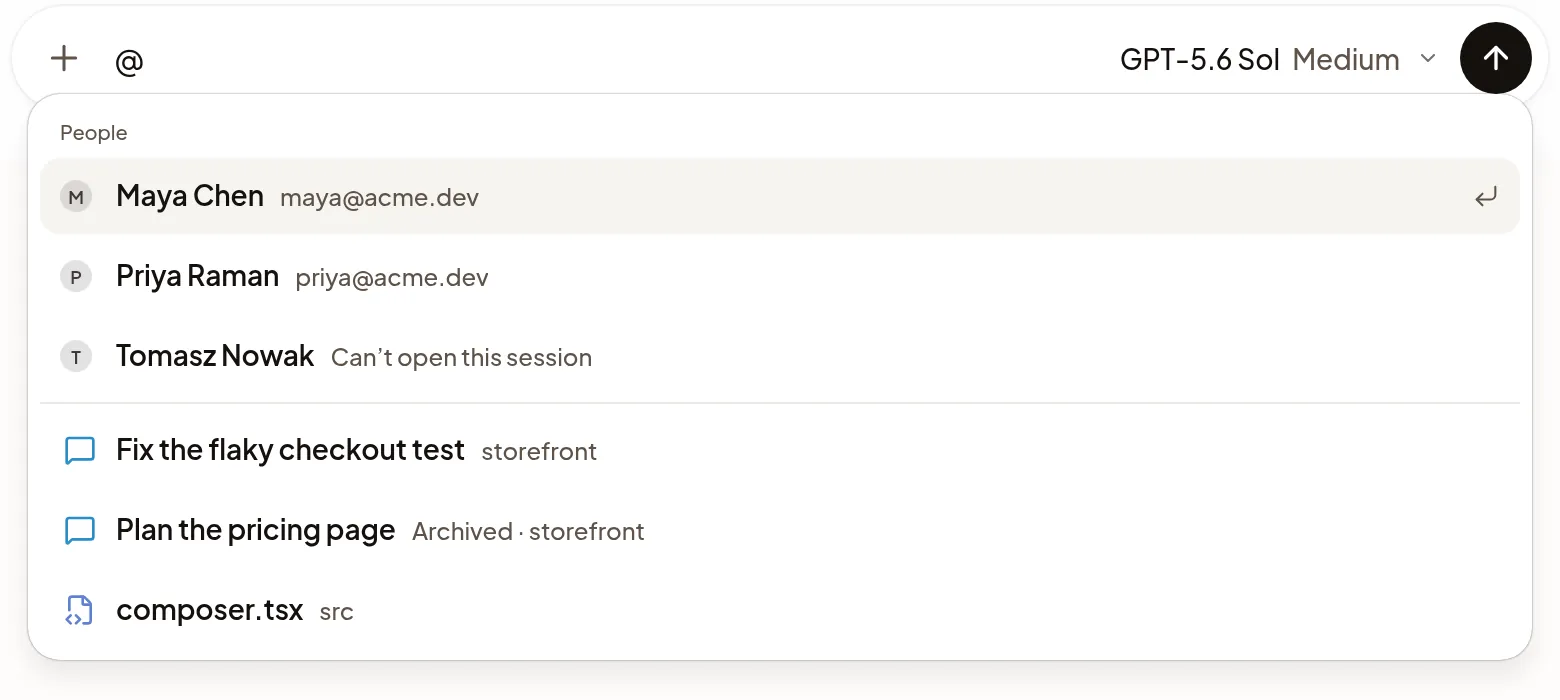
Point at files and Sessions
Type @, or select + → Mention a file or folder, and choose from the
list. Keep typing to narrow it, spaces included: @release notes finds a
Session or file by those words. The list closes, leaving what you typed as
text, when nothing matches after a space (a single letter waits for more), at
two spaces in a row, or when a space follows the @ straight away, as in
“meet @ 5pm”. Inside quotes,
@"…", spaces never close it. Putting the caret back in an earlier mention
reopens its list, unless you closed it with Esc or it closed by
itself.
- People come first, in a Session of a team organization: teammates you can bring into this Session. See Mention a teammate.
- Sessions follow: other Sessions you can open in this organization, such as one a teammate shared with you. Recent ones are listed until you type; then Polaris finds them by name, Project or organization. The agent reads that Session; nothing is sent to it.
- Files and folders from the repository follow. Choosing one puts its path in your message. When what you type looks like a path, files come first. While the Machine isn’t ready, the list shows the Machine’s last saved files, as Files describes.
- Sessions found by what was said in them, the way Search finds them, come last, each with the words that matched.
While the list is open, Enter or Tab picks the highlighted item. If there is nothing to pick, Enter closes the list instead of sending; press it again to send. When the list could not load, Enter tries again instead, and Esc closes it.
Mention a teammate
Type @ and choose someone under People, or type their name or email to
find them. Your message goes to the agent as usual, with their name in it,
such as @Maya Chen. The Session joins their list with an @ in place of
its time until they open it; see What needs you.
- Someone who can’t open the Session yet shows Can watch once you send in the list. Their name in your message has an eye instead of the @; hover or focus it to read “Tomasz can’t open this session yet. Sending lets them watch it.” Sending shares it with them with Can watch. Only the Session’s owner can do this; see Share a Session.
- In someone else’s Session, people who can’t open it show Can’t open this session and can’t be chosen. Ask the owner to share it with them first.
Use a skill
Type /, or select + → Use a skill, to pick one of the agent’s skills
or your repository’s. Choosing a skill inserts its invocation in your
message. Project and personal skills you add in Settings show
Project or Personal beside their name.
If the menu says Project and personal skills need a newer Machine, that Machine cannot receive them. The skills already listed remain available.
You can also use these commands:
/compactshrinks a long conversation when the agent runs low on context. When the agent reports it, a ring beside the model shows how much is used; hover, focus or tap it for the numbers. With Claude Code, the panel can also break down the context by category: expand MCP tools or Memory files to see their token counts. The breakdown appears once the agent reports it after a reply; until then the panel shows only the totals. The footer shows when the reading was taken. Click the ring to keep the panel open, then press Esc or click outside it to close it./recapworks in every Session. Text after it gives instructions for the conversation recap.
Attach screenshots, logs and files
Select + → Attach files, press Ctrl+U
(⌘+U on a Mac), or drag or paste into the composer. The
agent sees images directly, and other files, a .zip included, land on its
Machine for it to open. Each image can be up to 25 MiB, and other files up to
1 GiB.
A long paste folds into a chip such as Pasted text · 120 lines. Select it to read what you pasted; the agent gets all of it. A message can carry up to 8 MiB of text; attach anything longer as a file.
Quote the transcript
To reply to one exact sentence, plan step or line of output, select the text in any message and choose Add to chat. Add a comment if you like, then send. The agent gets your message followed by each quote and its comment. To comment on lines of the diff instead, see Review changes.
Dictate a message
Select Dictate, the microphone, or press Ctrl+Shift+D (⌘+Shift+D on a Mac), and talk. When you’re done, choose what happens next:
- Select Stop and insert, the square, or press the shortcut again to add your words where your cursor was. You can keep editing before you send.
- Select Send, the up arrow, to add your words and send the message. On Start, the arrow is Start and starts the Session.
Press Esc to throw the recording away. A closed tab doesn’t lose a recording. Polaris sends your audio to OpenAI to turn it into text, and only you can play it back.
If your words can’t be turned into text right away, for example while you’re offline, the recording waits above the composer and you can keep writing and sending. Once it can be turned into text, the words are added to the end of what’s in the composer, even if you’ve sent a message since; they aren’t sent by themselves. Select Retry to try again now.
Choose the model and take a suggestion
- The controls next to the send button set the model, effort and Permissions for your next message; see Choose the agent. Messages already queued keep the settings they were sent with.
- After the agent replies, the empty composer can suggest a next message. Press Tab to take it. To stop suggestions, turn off Next-message suggestions in Settings → General.
- If you send while scrolled up in the transcript, Polaris scrolls down to your message. To stay where you are, set When you send from earlier messages to Stay where I am in Settings → General.
If it doesn’t work
- Upload failed on an attachment: select Retry.
- Image is larger than 25 MiB.: attach a smaller image.
- Files and folders could not be searched.: select Retry in the list.
- Conversations could not be searched. Keep typing to try again.: Sessions found by name still show; type another letter to search again.
- For anything else, see Troubleshooting.